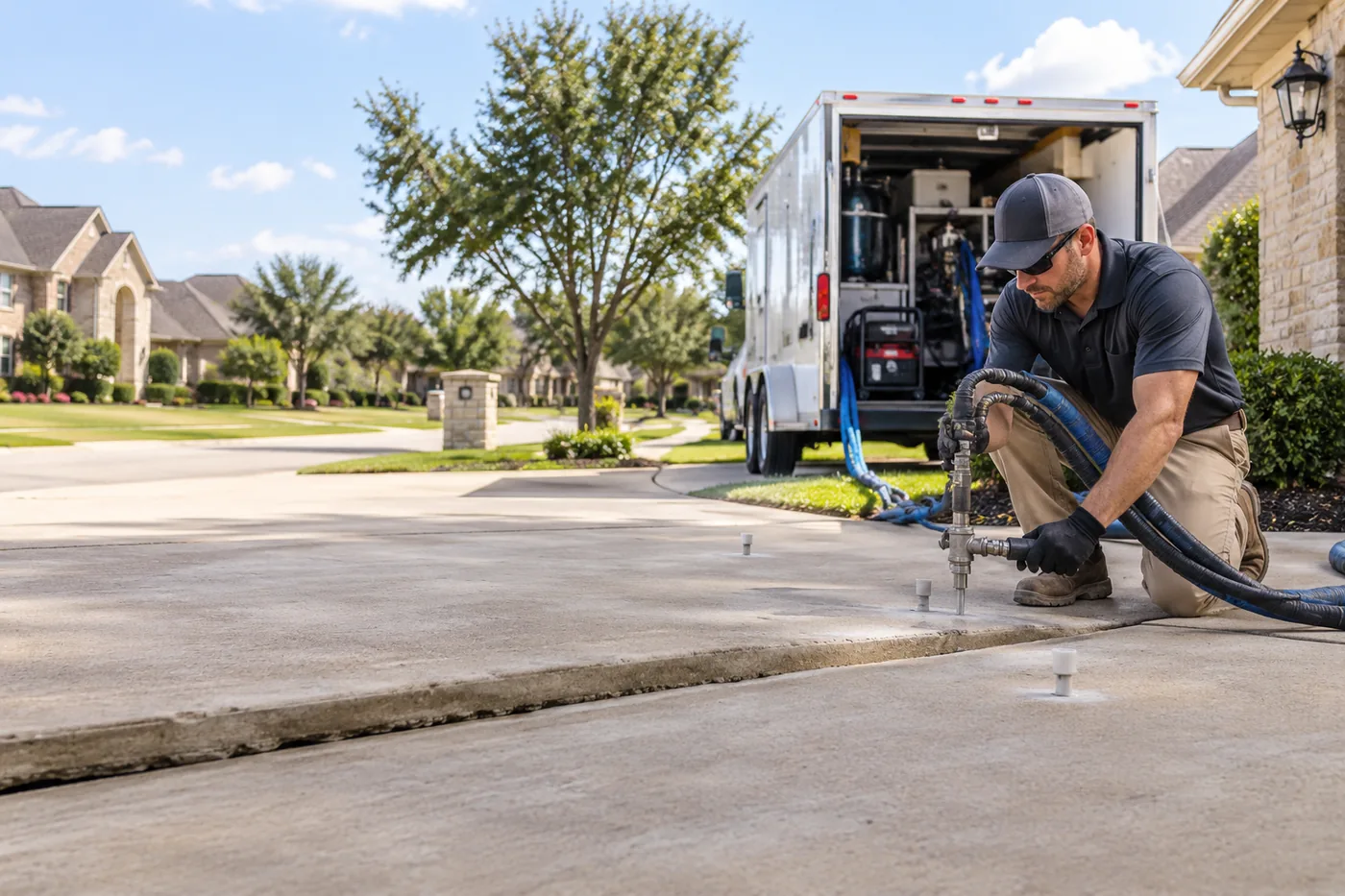
How mudjacking works
The process starts with an evaluation of the slab: how far it has settled, whether it is cracked or crumbling, and what may have caused the soil beneath it to move. If the slab is a candidate, the crew drills a series of holes through the concrete, usually in a grid pattern across the low areas.
A slurry made from cement, sand or soil, and water is then pumped through the holes under pressure. As the mixture fills voids beneath the slab, hydraulic pressure raises the concrete. The technician watches the elevation and adds material in stages so the lift stays controlled. When the target height is reached, pumping stops, the holes are patched with cement, and the surface is cleaned up.
Because the slurry is heavy and needs time to cure, the repaired area is typically kept free of heavy loads for a period after the work. A provider can explain the specific wait time for your project during the quote.
Mudjacking vs. polyjacking
The method most often compared with mudjacking is polyjacking, which uses expanding polyurethane foam instead of cement slurry. Both approaches raise concrete by filling space beneath the slab, but the materials behave differently.
Mudjacking slurry is considerably heavier than polyurethane foam. On Houston's soft, expansive clay, added weight is worth discussing, since the goal is to stabilize the slab rather than load already-weak soil. Polyjacking uses smaller injection holes and a lightweight material that expands to fill voids, and it typically cures faster.
Mudjacking is often the lower-cost option of the two, which makes it attractive for larger areas or budget-conscious projects. The right choice depends on the slab, the soil, access, and what a provider recommends after seeing the site. Our polyjacking vs. mudjacking guide walks through the differences in more detail, and you can read about the foam method on our foam concrete leveling page.
When mudjacking is the right choice in Houston
Mudjacking tends to fit projects where the voids beneath the slab are substantial and the concrete itself is still in reasonable shape. It is commonly used for residential driveways, sidewalks, patios, and garage approaches, as well as larger commercial slabs where the lower material cost matters.
It can also be a practical pick when the settlement is straightforward — for example, a driveway panel that has dropped because the soil beneath it was never fully compacted — and there are no active drainage problems undermining the area.
Mudjacking for commercial slabs
Parking lots, warehouse floors, walkways, and other commercial concrete are frequent mudjacking candidates. The method scales well to large areas, and the lower material cost compared with polyurethane foam can make a real difference on big square footage. As with residential work, the slab needs to be intact enough to lift, and drainage around the building should be part of the evaluation.
Houston soil and why slabs settle here
Much of Greater Houston sits on expansive clay that swells when wet and shrinks during dry spells. That constant movement, combined with heavy rain events and long dry stretches, opens voids under concrete over time.
Poor compaction during construction, erosion from roof runoff or broken drainage, and plumbing leaks can speed the process up. When support disappears, the slab follows gravity and settles.
What mudjacking does not fix
Mudjacking raises concrete; it does not repair concrete that is crumbling, flaking apart, or broken into separate pieces that can no longer move as a unit. It also does not correct the underlying cause of settlement. If water is still washing soil from beneath the slab, or drainage is directing runoff against it, those issues should be addressed alongside the lift, or the problem can return.
Mudjacking cost factors in Houston
Pricing depends on the size and number of slabs, how far the concrete has dropped, how much void needs filling, access for equipment, and the number of injection points. A small sidewalk section and a full driveway are very different projects.
For a breakdown of what drives concrete raising prices in the area, see our Houston concrete leveling cost guide. The most reliable number always comes from a site-specific quote.
Why mudjacking persists in the foam era
Polyurethane foam gets most of the attention in concrete leveling marketing, but mudjacking has been raising slabs for decades and remains a legitimate choice. The equipment is simpler, the materials are inexpensive and widely available, and the method is well understood by experienced crews.
For large commercial projects — parking lots, warehouse aprons, long sidewalk runs — the material savings over foam can be substantial. And for straightforward residential settlement with no complicating factors, mudjacking delivers a solid, long-lasting lift without paying for foam's premium. The key is matching the method to the project, not defaulting to whatever is newest.
Request a mudjacking quote in Houston
Call (832) 662-7711 or request a free quote and describe the settled concrete — where it is, how far it has dropped, and how long it has been moving. Photos of the slab and the uneven joints help make the first review more useful.